
Media Releases
#IMESANEWS
IMESA’s Role in Advancing Municipal Engineering
Explore how IMESA is dedicated to driving innovation and supporting public service initiatives, contributing to the growth and sustainability of municipal engineering.
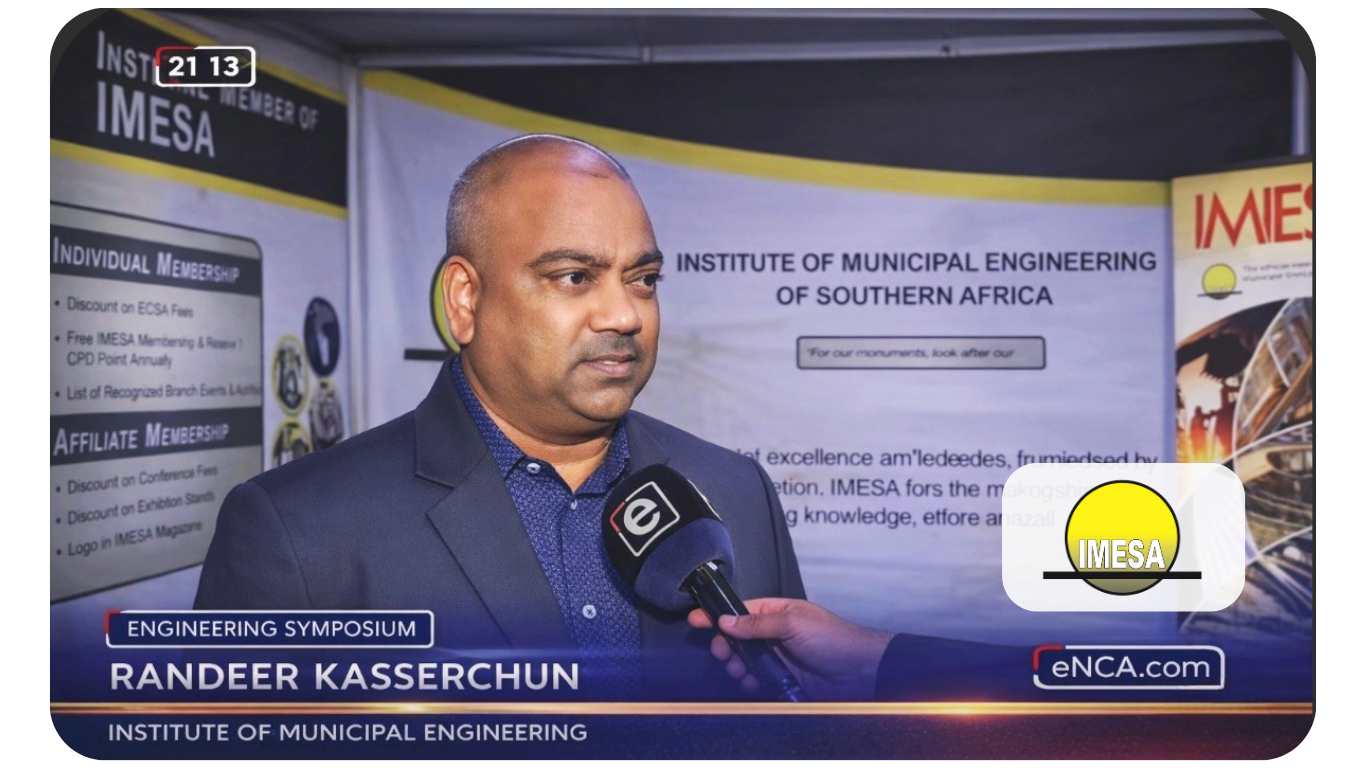
IMESA represented at the ECSA & SAICE Symposium
The Institute of Municipal Engineering of Southern Africa (IMESA) has welcomed President Cyril Ramaphosa’s National Water Action Plan (NWAP) but says that the professional registration of senior municipal officials should be a central pillar of the strategy. The organisation asserts that water sector reform will only succeed if municipalities are led by competent, professionally registered officials who are accountable to both their municipality and their professional body.
The President released the NWAP on 23 July 2026 following a meeting of the National Water Crisis Committee (WATERCOM) at the Union Buildings in Pretoria. The plan sets out short, medium and long-term interventions aimed at securing a reliable supply of quality water to all South Africans. It includes increased infrastructure investment, legal and regulatory reform, and measures to address corruption and criminality in the water sector.
IMESA president Geoff Tooley says that the plan’s emphasis on institutional reform should include the professional registration of senior municipal officials.
Tooley explains that the specific profession in which the administrators are registered is not important. “Senior officials could come from disciplines including law, town planning, engineering, accounting or land surveying, provided they are professionally registered with the relevant body.” The benefit of this, he says, is that professional registration will create a dual accountability framework: senior officials will be accountable to their municipalities while also being subject to the standards and requirements of their professional bodies.
“This will give professional ethics greater weight in public administration. Failure to act professionally could ultimately affect an official’s professional status and, where professional registration is a requirement of the post, their ability to remain in that position.
“This would make accountability and professional ethics paramount and this culture would permeate through our public organisations. The right decisions would be made for the right reasons, supporting a turnaround in service delivery.”
IMESA director Bhavna Soni says that the immediate priority should also be to stabilise and maintain the infrastructure already in place. “Getting back to basics means fixing what we have,” she stresses, highlighting the importance of adequate maintenance budget allocations for managing and stabilising existing water systems.
Soni welcomes the NWAP’s commitment to ring-fencing water revenues, noting that financial sustainability is critical to the future of municipal water and sanitation services. Reducing non-revenue water (NRW) and increasing water sales are similarly vital to improve financial sustainability. “To achieve this, we need mechanisms to formalise service arrangements and revenue collection in rural and informal areas, including areas on Ingonyama Trust land,” Soni states. “With rural and informal areas increasing, the scope for cross-subsidisation is becoming more difficult, making sustainable revenue collection increasingly important.”
Soni calls for disaster-related damage to water infrastructure to be funded separately through National Treasury disaster funding, rather than placing additional pressure on normal municipal water and sanitation budgets.
She, too, stresses the importance of registered professionals at senior levels in municipalities. “Competent people are critical to financial sustainability, water security and better service delivery. Whatever their background – whether they are engineers, accountants or lawyers – they must be registered with and accountable to their professional body.”
In addition to competence and professionalism, Soni says that ethical leadership is essential to improve municipal performance. “True leadership means guiding others with integrity, honesty, fairness and personal responsibility while focusing on the common good rather than personal gain.”
The NWAP identifies weaknesses in the existing municipal water-services model, including the use of water revenues to fund other municipal functions, which reduces resources available for maintenance, investment and skilled staff. It also identifies diffuse accountability as a factor weakening incentives for effective and financially sustainable water management.
Soni notes that the Metro Trading Services Reform (MTSR) framework addresses these issues effectively through its seven-box matrix but says and that the effective implementation of the programme is critical.
She contends that one of the most vital reforms is to ensure that every municipality’s Water and Sanitation Unit operates as a utility. This means treating these services like a self-sustaining business that must manage its own funds, operations and infrastructure efficiently rather than relying strictly on municipal general budgets.
IMESA believes that the NWAP provides an important national framework, but its success will ultimately depend on its implementation at municipal level, including financial discipline, infrastructure maintenance, effective revenue management and ethical, accountable, professional leadership. “As the saying goes: ‘Vision without execution is just hallucination.’”
The Institute of Municipal Engineering of Southern Africa (IMESA) has announced the programme for its 2026 conference, which takes place in Durban next month. The topics on the agenda include some of the most urgent challenges facing local government in South Africa, including water security, flooding, informal settlements, infrastructure resilience, procurement and technical capacity. IMESA urges all industry stakeholders – including engineers, municipal leaders, academics and private sector partners – to attend the event.
The timing of this year’s 89th annual IMESA Conference and Exhibition could not be more critical, the institute says. South Africa’s water infrastructure is under severe strain. Of 144 Water Services Authorities (WSAs) assessed nationally, 107 were rated poor or critical in terms of their drinking water systems, while 81% of municipal wastewater infrastructure was assessed as being in a poor or critical condition. Non-revenue water averages 47%, representing a massive loss of treated water before it generates revenue. Against this backdrop, the IMESA Conference will examine practical approaches to strengthening municipal water and sanitation services and improving water security in stressed communities.
Climate resilience is another important theme running through the programme, with presentations exploring affordable forecasting systems, improved design practices and the ability of cities to respond effectively when extreme weather strikes. A dedicated panel discussion will examine how cities can rethink disaster response when they come under increasing pressure. With catastrophic flooding in Limpopo and Mpumalanga earlier this year having claimed lives and destroyed homes and critical infrastructure, it is essential that we focus our attention on South Africa’s vulnerability to extreme weather, IMESA states.
The conference will also explore how municipalities can respond to rapid urban densification and informal settlement growth, harness digital technologies and drones to improve infrastructure management, and strengthen the technical and organisational capacity needed to deliver public infrastructure effectively. Drone technology has the potential to advance water and sanitation management. IMESA stresses that municipalities must move beyond fragmented digital initiatives, noting that digital tools can deliver better visibility and data on infrastructure condition, failures and service networks, to help municipalities prioritise maintenance and investment.
The focus on procurement at the conference is particularly timely as municipalities face scrutiny over irregular expenditure and tenders, project delays, cost escalation, contractor appointments and the inability to translate capital budgets into functioning infrastructure.
Sustainability is in the spotlight, too, with discussions around recycled and alternative construction materials, particularly for low-cost housing; sustainable riverbank protection; and the long-term management of municipal landfill capacity.
With municipalities under pressure to deliver more with limited resources, the 2026 IMESA Conference and Exhibition provides a vital platform for the engineering profession and local government stakeholders and role players to learn, share knowledge and network. This year’s theme, “Blueprints Reimagined Judiciously”, reflects the imperative in today’s widely troubled municipalities to take existing plans, standards and long‑established methods of designing public infrastructure and rethink them, IMESA says. “We must refine and adapt traditional methods and integrate new technologies, smarter planning and collaborative approaches to meet today’s local government and service delivery realities.”
The IMESA Conference & Exhibition takes place at the ICC in Durban from 28 to 30 October 2026. To find out more, to view the full programme or to register to attend the event, visit https://conference.imesa.org.za/ or email conference@imesa.org.za
This Women’s Month, amid the usual flurry of stories focusing on underrepresentation and strategies to drive gender equity, the Institute of Municipal Engineering of Southern Africa (IMESA) is flipping the narrative.
Since its establishment in 1961, IMESA has never implemented any formal gender policies, the organisation says. It has simply strived to build a professional home for all municipal engineers, where technical excellence, ethics and service to communities are the common ground. Inclusion has followed naturally, and today, more than 30% of IMESA’s members are women. Many of them serve the organisation in leadership roles, including branch chairpersons Roxanne Canny in KwaZulu-Natal, Princesse Kabala Muke in the Western Cape and Mpho Plaatjie for IMESA’s Free State and Northern Cape branch.
They share their stories this Women’s Month not to talk about barriers but about opportunities, and to encourage the next generation of young women to see engineering as a place where they can innovate, lead and help shape South Africa’s future. For every young woman wondering whether she belongs in engineering, their message is clear: if you have a passion for solving problems and improving lives, consider engineering. More specifically, they urge all learners, students, graduates and young professionals to consider municipal engineering, which is about building the infrastructure that enables communities to thrive.
The opportunity to contribute to infrastructure that provides essential services such as water, sanitation, roads and public facilities is what inspired civil engineer and Mangaung Municipality project manager Mpho Plaatjie to pursue this career, and she says that purpose continues to drive her today. Her career journey started at a young age, growing up in a small town where water was a scarce resource. “Like many families, we did not have running water. One of the defining moments of my childhood was when a private company was installing a water tap in our yard, and my job was to make sure that my friends did not play with the newly installed water meter. Watching the technicians’ work fascinated me. I asked countless questions about how the system worked and how water reached our home. I realised that I wanted to be part of creating solutions for communities like mine. I wanted to ensure that no child would have to grow up without access to something as fundamental as clean, running water.”
Now a registered civil engineer specialising in water design and working as an area project manager at eThekwini Municipality, the young Roxanne Canny was inspired by her draughtswoman mom and then drawn to water engineering because it applies problem-solving to real challenges that people face every day. “I started my career in consulting, designing water infrastructure projects for both municipal and private sector clients. Joining eThekwini Municipality gave me the opportunity to see projects through to implementation, and I found that incredibly rewarding. That’s when I knew municipal engineering was where I wanted to build my career. It’s a space where I feel I can make a real, tangible impact, and that’s what has kept me passionate about it throughout my career.”
Africa Vision 2035, which featured extensively in her university assignments, is what led Princesse Kabala Muke to pursue a career in engineering. “The vision of a futuristic Africa with interconnected megacities and infrastructure where every child is safe and provided for is something I want to help realise.” Growing up in Goma, in the eastern Democratic Republic of Congo, Princesse says that she witnessed first-hand how access to infrastructure such as roads, water, sanitation and public services directly influences the quality of life and opportunities available to communities. “I realised that engineering is more than a technical profession, it is a powerful tool for nation-building, economic development and social transformation.”
Today, as acting manager in the City of Cape Town’s Urban Waste Management division, she leads large multidisciplinary teams responsible for delivering essential public services. “Municipal engineering has given me a deep appreciation for the direct impact our work has on people’s daily lives. Every clean street, every waste collection service and every infrastructure investment contributes to healthier, safer and more dignified communities. The decisions I make today create more resilient and sustainable cities for tomorrow.”
Over the past ten years, Roxanne has planned, designed and implemented major water infrastructure projects, while also leading teams and mentoring young engineers. She believes that mentorship is critical. “Looking back, I’ve learnt so much from people who were willing to share their knowledge and encourage me along the way. I think we all have a responsibility to do the same for the next generation.”
It is this responsibility that led Roxanne to co-found IMESA’s Young Professionals Portfolio (dubbed YP²) to create more opportunities for students and young engineers. “This is one of the achievements that I am most proud of, and it’s been incredibly rewarding to see how it has grown,” she says. That growth has included the recent launch of YP² in the Western Cape, driven by branch chair Princesse and geared towards helping IMESA build future engineering leaders who are technically competent, ethical and committed to public service.
All three women are upbeat about the engineering profession’s transformation over the years, and the fact that it is now more inclusive and welcoming to women. “Today, there are more women entering engineering, leading technical teams, managing infrastructure programmes and occupying executive leadership positions than ever before,” Mpho says, but she adds that municipalities should still be working to strengthen internship and graduate programmes, and offer bursaries.
Roxanne notes that the conversation around women in engineering has changed. “People are recognising that diversity isn’t about meeting targets; it’s about bringing different perspectives to the table, and that’s making our profession stronger.”
“We need to continue creating environments where women are not only present but are empowered to lead, innovate and influence strategic decisions,” Princesse stresses.
They agree, too, on the importance of professional communities, like IMESA, which offer mentorship, technical support, networking opportunities and leadership development that are invaluable throughout an engineer’s career. For women in engineering, these communities are particularly important, they contend, because they provide visible role models and a supportive environment where women can share experiences, learn from one another and develop into future leaders.
This Women’s Month, the most important advice that these engineers have for young girls and women considering engineering as a career is that they belong and can make a real impact in the municipal engineering field.
“Engineering is an incredibly rewarding career if you enjoy solving problems and making a difference,” Roxanne advises.
“Believe in yourself and never allow stereotypes to define your future,” stresses Mpho.
“Never underestimate the impact you can have on your community and your country through engineering,” Princesse concludes.
Press links:
IOL (Business) 10 Aug 2026 Women engineers driving South Africa’s infrastructure inspire next generation: Link
Sunday Tribune 10 Aug 2026 Women in engineering: Shaping South Africa’s infrastructure future: Link
Cape Times 11 Aug 2026 Women engineers leading South Africa’s infrastructure transformation: Link
Against the backdrop of the devastating floods currently affecting parts of the Western Cape, the Institute of Municipal Engineering of Southern Africa (IMESA) has highlighted the urgent need for improved municipal flood preparedness, planning and governance.
The institute has just wrapped up a series of flood risk workshops aimed at creating greater awareness among councillors and municipal officials about the realities of flood risks, their legal responsibilities, infrastructure vulnerability and the importance of scientifically informed planning. The training sessions, hosted in partnership with sector stakeholders including the Water Research Commission (WRC) and the South African Local Government Association (SALGA), were held in Thohoyandou in Venda, in East London, Makhanda, Pretoria, Newcastle and Moorreesburg in the Western Cape, reaching municipal representatives from multiple provinces and municipalities.
This IMESA initiative was rolled out at a critical time for South Africa as severe flooding events are demonstrating the importance of flood preparedness in urban planning, stormwater infrastructure, disaster management coordination and development control processes. IMESA explains that the workshops were specifically designed to help councillors better understand the technical, legal and governance dimensions of flood management, while reinforcing the importance of protecting lives, infrastructure and economic activity.
“Flood risk management is no longer a niche technical issue. It is a governance issue, a planning issue and ultimately a public safety issue,” IMESA notes. “Municipal decision-makers play a critical role in ensuring that development takes place responsibly and that communities are protected from avoidable flood risks.”
The workshops provided comprehensive guidance on flood risk understanding, design flood estimation, municipal legal obligations, land-use planning, stormwater management and disaster preparedness. The training content covered the fundamentals of what constitutes a flood, factors influencing flood behaviour and the growing complexity of flood modelling in an era of urbanisation and climate uncertainty. Participants explored how topography, soil conditions, vegetation, infrastructure development, catchment response and rainfall intensity all influence flood severity.
Special attention was given to the concept of residual risk, which is the increasing threat today of flooding events larger than the design standard typically used in infrastructure planning. IMESA explains that as urban populations grow and climate pressures intensify, municipalities globally are increasingly considering more severe flood scenarios, including 1 000-year flood events, as part of modern flood risk planning.
The workshops also emphasised the strong relationship between urban planning, stormwater management and disaster management, underscoring the need for municipal departments to collaborate and to maintain accurate infrastructure asset registers, reliable rainfall data and updated flood records. Among the key themes covered were the importance of data quality and technical expertise in flood estimation and infrastructure planning. Municipal leaders were cautioned against relying on inadequate or poor-quality information, with the IMESA trainers warning that inaccurate data can significantly compromise flood event analysis and infrastructure design outcomes.
The workshops also addressed the distinction between natural uncertainty in weather systems and uncertainty arising from insufficient knowledge or technical capacity. IMESA stresses the need for experienced and professionally registered practitioners in flood hydrology, hydraulics and flood management.
The legal and regulatory responsibilities of municipalities formed a major component of the workshops. Councillors were guided through relevant legislation, including the Constitution, National Water Act, Water Services Act, Municipal Systems Act, Disaster Management Act and National Building Regulations.
The sessions outlined municipalities’ obligations to identify and manage flood lines, regulate development within flood-prone areas, maintain appropriate bylaws and ensure that qualified professionals are appointed to undertake flood-related assessments and planning. According to IMESA, many councillors expressed surprise at the extent of municipalities’ legal accountability relating to floodplain development and unsafe settlement patterns.
Feedback from participants also revealed that many elected representatives had not previously understood the importance of professionally registered engineers and scientists in floodline determinations, nor the significance of maintaining accurate local rainfall and infrastructure data.
Councillors acknowledged the need for stronger alignment between disaster management departments and municipal stormwater divisions, recognising that flood resilience requires coordinated planning and information-sharing across departments.
Importantly, many participants mistakenly believed that every flood event can simply be attributed to climate change, IMESA reports. This misconception was addressed in the workshops and the councillors gained a deeper understanding of the multiple technical and planning factors that contribute to flood disasters.
IMESA says that the workshops reinforced the need for municipalities to move beyond reactive disaster response and instead adopt proactive, risk-informed planning approaches.
“Flood resilience starts long before a storm arrives,” the institute stresses. “It requires careful planning, sound engineering judgment, reliable data, effective bylaws, skilled professionals and political leadership that understands the long-term implications of development decisions.”
The positive response from councillors has prompted calls for additional workshops and ongoing engagement sessions.
As South Africa confronts increasingly complex infrastructure and climate challenges, IMESA believes that empowering municipal leaders with technical knowledge and governance awareness will be essential to reducing future flood risks and protecting vulnerable communities.
The ECSA & SAICE Symposium is a key industry platform that brings together regulators, professional bodies, and engineering leaders to engage on standards, professional development, and the future of engineering in South Africa. It serves as a strategic touchpoint for aligning the profession with national infrastructure priorities and ethical practice.
IMESA’s presence at this level reinforces its role as a critical voice within the municipal engineering space. Featuring past President, Randeer Kasserchun, in the interview positions the institution at the centre of industry dialogue demonstrating leadership, credibility, and active contribution to shaping the sector.
Media Release :
”Engineers urged to rethink traditional approaches to infrastructure planning, delivery and sustainability amid challenges in South African municipalities”
As South African cities face aging infrastructure, climate risks, growth pressures and budget constraints, The Institute of Municipal Engineering of Southern Africa (IMESA) is calling on the municipal and civil engineering sector to rethink how infrastructure is planned, delivered and sustained.
The organisation has announced that its 2026 conference and exhibition, South Africa’s leading platform for the profession to learn, share knowledge and network, will be held under the theme “Blueprints Reimagined Judiciously”. Outlining the rationale, IMESA president Geoff Tooley says: “This theme reflects the imperative in today’s widely troubled municipalities to take existing plans, standards and long‑established methods of designing public infrastructure and rethink them. This is not about disruption for its own sake, but about careful, responsible, evidence-based evolution to address the growing pressures on infrastructure systems, including ageing assets, climate challenges, rapid urbanisation and stretched municipal budgets.
“As municipalities grapple with increasingly complex demands, the need to revisit traditional approaches has never been more urgent,” he expands. “The theme underscores the importance of balancing innovation with proven engineering principles, ensuring that progress is both sustainable and resilient. Rather than abandoning established practices, we are urging engineering professionals to refine and adapt them, integrating new technologies, smarter planning and collaborative approaches to meet today’s local government and service delivery realities.”
This year, the IMESA Conference & Exhibition moves to Durban, KwaZulu-Natal, taking place from 28 to 30 October 2026. Conference registration opens in April and IMESA invites all industry stakeholders – including engineers, municipal leaders, academics and private sector partners – to register early and ensure that they don’t miss the opportunity to help shape the future of South African cities and towns.
IMESA has issued a call for abstracts, inviting thought leaders, practitioners and researchers to contribute to this year’s programme. Submissions will be evaluated based on innovation, thought leadership, business value and alignment with the conference theme. The categories in which submissions are invited are:
- Buildings, structures and housing
- Ecological, environmental and social
- Electrical and electronic
- Financial, legal and regulatory
- Transport, roads and stormwater
- Water and sanitation
“We are putting together an impactful programme for 2026 that reflects the current challenges, emerging trends and practical solutions from across the sector. By sharing research, insights and case studies, contributors play a direct role in advancing our profession’s body of knowledge, improving service delivery and strengthening municipal engineering practices across Southern Africa,” Tooley says.
The deadline for abstract submissions is 10 April 2026.
Exhibitor packages and sponsorship opportunities for this year’s IMESA Conference & Exhibition have also been announced. With more than 800 delegates and over 80 exhibitors and sponsors participating in the 2025 IMESA Conference & Exhibition, Tooley notes that the event presents a valuable opportunity for companies to connect with a highly targeted audience of municipal decision-makers and engineering professionals.
“As municipalities increasingly seek innovative, cost-effective and sustainable solutions, the exhibition floor at the annual IMESA Conference provides an important space for showcasing products, services and technologies that can make a tangible impact.”
Since its founding in 1961, IMESA has been committed to advancing excellence in infrastructure engineering and supporting the professionals who drive it. The 89th IMESA Conference & Exhibition continues this mission, fostering informed dialogue, encouraging innovation and equipping the sector to meet the challenges of the future.
Media Release :
”The Power Of City Improvement Districts To Bolster Municipal Service Delivery”
South Africa’s first City Improvement District (CID) was established in Johannesburg’s central business district in the early nineties. Since then, the model has been helping to bridge the gap between basic municipal service delivery and the expectations of business and property owners, residents and communities around the country. The Institute of Municipal Engineering of Southern Africa says that CIDs are more important than ever today, with municipalities around South Africa facing resource and capacity constraints.
Despite some challenges and setbacks in the legislation and funding of CIDs, including disparities across different South African provinces, IMESA asserts that CIDs are a powerful tool for the revitalisation of business and residential areas. As evidenced in towns like Worcester, all municipalities, regardless of their size or grading, can benefit from the model and IMESA urges them to establish CIDs where possible, to learn from successful collaborations, share knowledge, processes and best practices.
A CID is essentially a public-private partnership between the municipality and private stakeholders like property owners, businesses or residents. These public sector role players agree to raise additional funds through levies to pay for services and improvements in a specified area. These are generally either above and beyond the mandate of the municipality or are needs that can be fast-tracked by the CID.
Jeanine du Preez, IMESA’s operations director of Marketing and Communications, says that the 55 CIDs operating successfully in the City of Cape Town (CoCT), along with numerous Memoranda of Agreement (MoAs) across the municipal area, show what partnerships like these can achieve. As a district head for Urban Mobility, Roads Infrastructure Management in the city, she sees the impact first hand. “These agreements cover not only industrial and commercial precincts, but also a significant number of residential neighbourhoods. Many of these CIDs are highly active and maintain strong working relationships and partnerships with the various Line Departments in the CoCT. Our approach is to support the rapid and efficient implementation of interventions wherever possible, guiding CIDs through the standard approval framework without compromising on workmanship, safety standards, or compliance with City policies and procedures. We want to see these areas flourish,” Du Preez states.
She notes that a number of CIDs actively participate in pothole repairs to help fast‑track routine maintenance within their areas. Safety and security initiatives are also key focus areas, particularly in residential environments. “Where a proposed intervention falls outside the direct mandate of the relevant Line Department, but is nonetheless supported, we make use of a Permissions Agreement. These agreements typically apply to items such as fencing, where the proposal aligns with City guidelines but the asset remains the property of the CID or organisation entering into the MOA. Under these arrangements, the CID retains full responsibility for the ongoing maintenance of such infrastructure.”
While the arrangement may sound onerous for capacity constrained engineering teams, Du Preez says that once a sound working relationship has been established and the CID/MOA partners fully understand the requirements for undertaking an intervention, the ongoing obligations on the City’s engineers are minimal. “While we still conduct a technical assessment for each application, this does not create duplication. If the CID did not submit the request, it would have originated from another source and would require the same level of review.
“In practice, we have found that CID‑driven interventions – such as pothole repairs, minor sidewalk reinstatements, repainting of road markings and general beautification of verges and medians – have meaningfully supported the City’s service delivery objectives. These efforts have contributed to a reduction in service notifications and have visibly uplifted the overall condition and appearance of the areas.”
Du Preez explains that each CID agreement outlines legal aspects, roles and responsibilities between the CID and the City’s Line Department. It also specifies the types of interventions supported, subject to a standard approval process and technical assessment. “The key success factor has been building strong partnerships with CIDs and assisting them in fast-tracking processes to demonstrate City support and alignment with the principles outlined in the City’s CID By-law. This stipulates that CIDs must enhance and supplement the municipal services contemplated under Section 8 of the Systems Act.”
Du Preez notes that these agreements do not transfer the Line Department’s responsibilities to the CID. “Routine City maintenance and programmes continue as normal. CID interventions are only approved if warranted and supported. Approval is not automatic.”
She explains that CIDs can fast-track their priorities and implement interventions outside the Line Department’s mandate. “For example, we allow CIDs to install fencing for security purposes (to City standards) via an additional Permissions Agreement. In such cases, the asset remains the property of the CID, and they are responsible for its maintenance. This approach is widely used as safety and security are high priorities for communities.”
Since an MOA is signed once and remains in effect until terminated under its conditions, operations between the City and the CID are streamlined.
The differences in the legislation applied and the funding model of CIDs in the City of Cape Town versus metros like Johannesburg, Ekurhuleni and Tshwane does pose challenges, IMESA concedes. In Cape Town, the municipality collects the extra rates for a CID. A 2015 Supreme Court of Appeal ruling in Randburg, Gauteng, found that mandatory levies like these which were being imposed under older provincial CID legislation could not be legally enforced. This effectively rendered the contributions voluntary unless formalised under updated by-laws or municipal policy. In response, Johannesburg adopted a draft Special Rating Areas By-law to provide clearer legal foundations for levy collection. This draft framework is still under consideration by other metros. In the meantime, the financial security and sustainability of some CIDs is uncertain as they must rely heavily on consensus and voluntary compliance. This is difficult when economic pressures are high or when property owners resist additional costs.
Despite these variations and challenges, however, CIDs across South Africa share common achievements that are worth highlighting, according to IMESA. Du Preez expands: “CIDS show that close collaboration between communities and municipalities works – improving public spaces, boosting property values, attracting investment and reducing crime. Where we have CIDS actively improving urban environments, investment follows. Job creation and social programmes are part of the CID value chain.”
IMESA says that knowledge sharing between metros can amplify the service delivery benefits offered by CIDs. “The successes in Cape Town’s mandatory CID levy model – particularly in planning, enforcement, budgeting, governance and accountability – offer a template that other towns and cities can adapt within their legislative frameworks. By fostering formal networks and collaborative platforms – such as inter-municipal forums, engineering institute knowledge exchanges and shared training programmes – metros can accelerate learning about CID establishment, community engagement processes and performance monitoring,” Du Preez concludes.
The Institute of Municipal Engineering of Southern Africa (IMESA) congratulates President Cyril Ramaphosa on his recent State of the Nation Address (SoNA) delivered on 6 February 2025. IMESA welcomes the announcement of the Medium Term Development Plan, particularly its focus on inclusive growth, job creation, poverty reduction, and the development of a capable, ethical, and professional public service.
“Achieving these objectives will require a government that truly serves the people, with a public sector that is both competent and accountable. This is where IMESA, as the representative body for professional municipal engineers, technologists, and technicians, is well-positioned to assist,” says Geoff Tooley PrEng, President of IMESA.
As a key player in municipal engineering, IMESA is already contributing to government’s development goals. Many of its members are actively engaged in initiatives such as the Presidential eThekwini Working Group, which is working to revitalise the metro’s performance.
Empowering Municipal Engineering Professionals
IMESA’s regional branches across South Africa serve as vital networks, connecting technical professionals within municipalities and offering mentorship and guidance. “Many of our young, skilled municipal engineers work in isolation, often as the only technical experts in their municipalities. Without proper support, they can feel overwhelmed by the challenges they face. IMESA provides them with access to experienced municipal engineers who offer valuable insight and networking opportunities,” explains Tooley.
A recurring concern raised by young professionals, particularly in medium to smaller municipalities, is the lack of technically trained leadership. “We often hear of engineering positions being filled by individuals who lack the necessary professional qualifications. Selection panels sometimes do not even include a single professional engineer. This leads to disillusionment among young professionals and contributes to the loss of critical skills in the public sector,” adds Tooley.
A Call for Collaborative Action
IMESA believes that tackling the challenges highlighted in SoNA requires a collaborative approach. “We stand ready to work alongside government to achieve our shared objectives. A fresh approach is needed to prioritise the recruitment of technically skilled and experienced professionals,” says Tooley.
While transformation and addressing historical inequalities remain essential, IMESA cautions against overly rigid equity requirements in infrastructure projects. “A balanced approach is crucial. Municipal engineering vacancies should be filled by appropriately qualified and registered engineers, including those in senior management roles at EXCO level. Experienced engineers are best placed to mentor and advance the careers of young professionals, regardless of race or gender,” Tooley stresses.
Additionally, IMESA urges municipal councils to strike a balance between developing new infrastructure and maintaining existing assets. “There must be effective two-way engagement between finance and engineering departments. IMESA is equipped to facilitate training and capacitate municipal decision-makers to ensure effective budget allocation,” he notes.
Upholding Ethics and Professional Standards
As a voluntary association, IMESA collaborates closely with the Engineering Council of South Africa (ECSA) to uphold ethical and professional standards in the industry. “We support ECSA’s Identification of Engineering Work (IDoEW) regulations and the establishment of an Office of the Engineer-General,” says Tooley.
IMESA also works with various government entities, including MISA, CIDB, COGTA, SALGA, and CBE, to address issues such as asset management, financial controls, and contract documentation. “We have actively contributed to the Local Government White Paper and the Public Procurement Act, ensuring that engineering expertise is incorporated into national policy discussions,” Tooley adds.
Commitment to Development Goals
Looking ahead, IMESA remains fully committed to supporting the government’s vision of a South Africa where all citizens have access to basic services and opportunities for prosperity. “Municipal engineers play a crucial role in nation-building, and IMESA will continue to advocate for policies and strategies that promote technical excellence and service delivery,” Tooley concludes.
Geoff Tooley PrEng, President of IMESA
For media enquiries, please contact:
Ingrid Botton – Head Office Manager / Institute Secretary
Contact Ingrid Botton – admin@imesa.org.za