
Media Releases
#IMESANEWS
IMESA’s Role in Advancing Municipal Engineering
Explore how IMESA is dedicated to driving innovation and supporting public service initiatives, contributing to the growth and sustainability of municipal engineering.
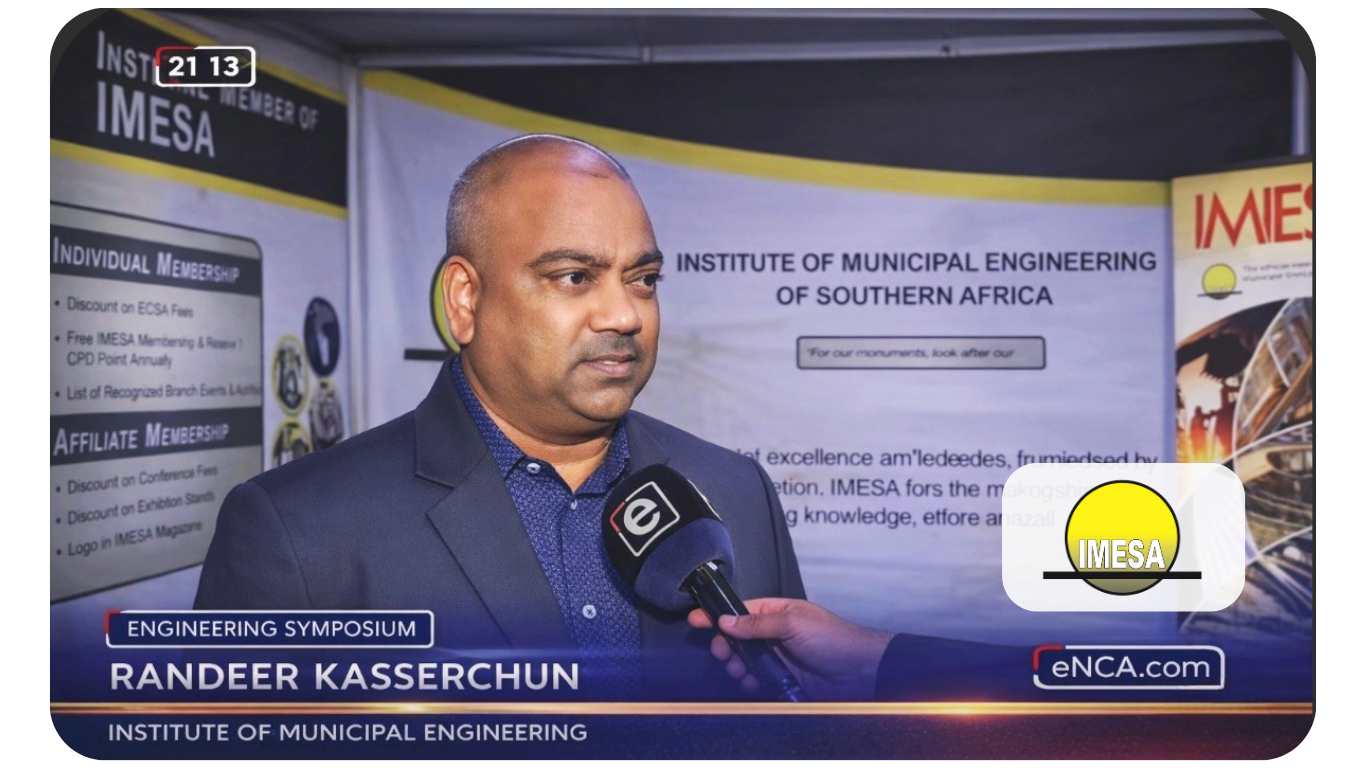
IMESA represented at the ECSA & SAICE Symposium
The ECSA & SAICE Symposium is a key industry platform that brings together regulators, professional bodies, and engineering leaders to engage on standards, professional development, and the future of engineering in South Africa. It serves as a strategic touchpoint for aligning the profession with national infrastructure priorities and ethical practice.
IMESA’s presence at this level reinforces its role as a critical voice within the municipal engineering space. Featuring past President, Randeer Kasserchun, in the interview positions the institution at the centre of industry dialogue demonstrating leadership, credibility, and active contribution to shaping the sector.
Media Release :
”Engineers urged to rethink traditional approaches to infrastructure planning, delivery and sustainability amid challenges in South African municipalities”
As South African cities face aging infrastructure, climate risks, growth pressures and budget constraints, The Institute of Municipal Engineering of Southern Africa (IMESA) is calling on the municipal and civil engineering sector to rethink how infrastructure is planned, delivered and sustained.
The organisation has announced that its 2026 conference and exhibition, South Africa’s leading platform for the profession to learn, share knowledge and network, will be held under the theme “Blueprints Reimagined Judiciously”. Outlining the rationale, IMESA president Geoff Tooley says: “This theme reflects the imperative in today’s widely troubled municipalities to take existing plans, standards and long‑established methods of designing public infrastructure and rethink them. This is not about disruption for its own sake, but about careful, responsible, evidence-based evolution to address the growing pressures on infrastructure systems, including ageing assets, climate challenges, rapid urbanisation and stretched municipal budgets.
“As municipalities grapple with increasingly complex demands, the need to revisit traditional approaches has never been more urgent,” he expands. “The theme underscores the importance of balancing innovation with proven engineering principles, ensuring that progress is both sustainable and resilient. Rather than abandoning established practices, we are urging engineering professionals to refine and adapt them, integrating new technologies, smarter planning and collaborative approaches to meet today’s local government and service delivery realities.”
This year, the IMESA Conference & Exhibition moves to Durban, KwaZulu-Natal, taking place from 28 to 30 October 2026. Conference registration opens in April and IMESA invites all industry stakeholders – including engineers, municipal leaders, academics and private sector partners – to register early and ensure that they don’t miss the opportunity to help shape the future of South African cities and towns.
IMESA has issued a call for abstracts, inviting thought leaders, practitioners and researchers to contribute to this year’s programme. Submissions will be evaluated based on innovation, thought leadership, business value and alignment with the conference theme. The categories in which submissions are invited are:
- Buildings, structures and housing
- Ecological, environmental and social
- Electrical and electronic
- Financial, legal and regulatory
- Transport, roads and stormwater
- Water and sanitation
“We are putting together an impactful programme for 2026 that reflects the current challenges, emerging trends and practical solutions from across the sector. By sharing research, insights and case studies, contributors play a direct role in advancing our profession’s body of knowledge, improving service delivery and strengthening municipal engineering practices across Southern Africa,” Tooley says.
The deadline for abstract submissions is 10 April 2026.
Exhibitor packages and sponsorship opportunities for this year’s IMESA Conference & Exhibition have also been announced. With more than 800 delegates and over 80 exhibitors and sponsors participating in the 2025 IMESA Conference & Exhibition, Tooley notes that the event presents a valuable opportunity for companies to connect with a highly targeted audience of municipal decision-makers and engineering professionals.
“As municipalities increasingly seek innovative, cost-effective and sustainable solutions, the exhibition floor at the annual IMESA Conference provides an important space for showcasing products, services and technologies that can make a tangible impact.”
Since its founding in 1961, IMESA has been committed to advancing excellence in infrastructure engineering and supporting the professionals who drive it. The 89th IMESA Conference & Exhibition continues this mission, fostering informed dialogue, encouraging innovation and equipping the sector to meet the challenges of the future.
Media Release :
”The Power Of City Improvement Districts To Bolster Municipal Service Delivery”
South Africa’s first City Improvement District (CID) was established in Johannesburg’s central business district in the early nineties. Since then, the model has been helping to bridge the gap between basic municipal service delivery and the expectations of business and property owners, residents and communities around the country. The Institute of Municipal Engineering of Southern Africa says that CIDs are more important than ever today, with municipalities around South Africa facing resource and capacity constraints.
Despite some challenges and setbacks in the legislation and funding of CIDs, including disparities across different South African provinces, IMESA asserts that CIDs are a powerful tool for the revitalisation of business and residential areas. As evidenced in towns like Worcester, all municipalities, regardless of their size or grading, can benefit from the model and IMESA urges them to establish CIDs where possible, to learn from successful collaborations, share knowledge, processes and best practices.
A CID is essentially a public-private partnership between the municipality and private stakeholders like property owners, businesses or residents. These public sector role players agree to raise additional funds through levies to pay for services and improvements in a specified area. These are generally either above and beyond the mandate of the municipality or are needs that can be fast-tracked by the CID.
Jeanine du Preez, IMESA’s operations director of Marketing and Communications, says that the 55 CIDs operating successfully in the City of Cape Town (CoCT), along with numerous Memoranda of Agreement (MoAs) across the municipal area, show what partnerships like these can achieve. As a district head for Urban Mobility, Roads Infrastructure Management in the city, she sees the impact first hand. “These agreements cover not only industrial and commercial precincts, but also a significant number of residential neighbourhoods. Many of these CIDs are highly active and maintain strong working relationships and partnerships with the various Line Departments in the CoCT. Our approach is to support the rapid and efficient implementation of interventions wherever possible, guiding CIDs through the standard approval framework without compromising on workmanship, safety standards, or compliance with City policies and procedures. We want to see these areas flourish,” Du Preez states.
She notes that a number of CIDs actively participate in pothole repairs to help fast‑track routine maintenance within their areas. Safety and security initiatives are also key focus areas, particularly in residential environments. “Where a proposed intervention falls outside the direct mandate of the relevant Line Department, but is nonetheless supported, we make use of a Permissions Agreement. These agreements typically apply to items such as fencing, where the proposal aligns with City guidelines but the asset remains the property of the CID or organisation entering into the MOA. Under these arrangements, the CID retains full responsibility for the ongoing maintenance of such infrastructure.”
While the arrangement may sound onerous for capacity constrained engineering teams, Du Preez says that once a sound working relationship has been established and the CID/MOA partners fully understand the requirements for undertaking an intervention, the ongoing obligations on the City’s engineers are minimal. “While we still conduct a technical assessment for each application, this does not create duplication. If the CID did not submit the request, it would have originated from another source and would require the same level of review.
“In practice, we have found that CID‑driven interventions – such as pothole repairs, minor sidewalk reinstatements, repainting of road markings and general beautification of verges and medians – have meaningfully supported the City’s service delivery objectives. These efforts have contributed to a reduction in service notifications and have visibly uplifted the overall condition and appearance of the areas.”
Du Preez explains that each CID agreement outlines legal aspects, roles and responsibilities between the CID and the City’s Line Department. It also specifies the types of interventions supported, subject to a standard approval process and technical assessment. “The key success factor has been building strong partnerships with CIDs and assisting them in fast-tracking processes to demonstrate City support and alignment with the principles outlined in the City’s CID By-law. This stipulates that CIDs must enhance and supplement the municipal services contemplated under Section 8 of the Systems Act.”
Du Preez notes that these agreements do not transfer the Line Department’s responsibilities to the CID. “Routine City maintenance and programmes continue as normal. CID interventions are only approved if warranted and supported. Approval is not automatic.”
She explains that CIDs can fast-track their priorities and implement interventions outside the Line Department’s mandate. “For example, we allow CIDs to install fencing for security purposes (to City standards) via an additional Permissions Agreement. In such cases, the asset remains the property of the CID, and they are responsible for its maintenance. This approach is widely used as safety and security are high priorities for communities.”
Since an MOA is signed once and remains in effect until terminated under its conditions, operations between the City and the CID are streamlined.
The differences in the legislation applied and the funding model of CIDs in the City of Cape Town versus metros like Johannesburg, Ekurhuleni and Tshwane does pose challenges, IMESA concedes. In Cape Town, the municipality collects the extra rates for a CID. A 2015 Supreme Court of Appeal ruling in Randburg, Gauteng, found that mandatory levies like these which were being imposed under older provincial CID legislation could not be legally enforced. This effectively rendered the contributions voluntary unless formalised under updated by-laws or municipal policy. In response, Johannesburg adopted a draft Special Rating Areas By-law to provide clearer legal foundations for levy collection. This draft framework is still under consideration by other metros. In the meantime, the financial security and sustainability of some CIDs is uncertain as they must rely heavily on consensus and voluntary compliance. This is difficult when economic pressures are high or when property owners resist additional costs.
Despite these variations and challenges, however, CIDs across South Africa share common achievements that are worth highlighting, according to IMESA. Du Preez expands: “CIDS show that close collaboration between communities and municipalities works – improving public spaces, boosting property values, attracting investment and reducing crime. Where we have CIDS actively improving urban environments, investment follows. Job creation and social programmes are part of the CID value chain.”
IMESA says that knowledge sharing between metros can amplify the service delivery benefits offered by CIDs. “The successes in Cape Town’s mandatory CID levy model – particularly in planning, enforcement, budgeting, governance and accountability – offer a template that other towns and cities can adapt within their legislative frameworks. By fostering formal networks and collaborative platforms – such as inter-municipal forums, engineering institute knowledge exchanges and shared training programmes – metros can accelerate learning about CID establishment, community engagement processes and performance monitoring,” Du Preez concludes.
The Institute of Municipal Engineering of Southern Africa (IMESA) congratulates President Cyril Ramaphosa on his recent State of the Nation Address (SoNA) delivered on 6 February 2025. IMESA welcomes the announcement of the Medium Term Development Plan, particularly its focus on inclusive growth, job creation, poverty reduction, and the development of a capable, ethical, and professional public service.
“Achieving these objectives will require a government that truly serves the people, with a public sector that is both competent and accountable. This is where IMESA, as the representative body for professional municipal engineers, technologists, and technicians, is well-positioned to assist,” says Geoff Tooley PrEng, President of IMESA.
As a key player in municipal engineering, IMESA is already contributing to government’s development goals. Many of its members are actively engaged in initiatives such as the Presidential eThekwini Working Group, which is working to revitalise the metro’s performance.
Empowering Municipal Engineering Professionals
IMESA’s regional branches across South Africa serve as vital networks, connecting technical professionals within municipalities and offering mentorship and guidance. “Many of our young, skilled municipal engineers work in isolation, often as the only technical experts in their municipalities. Without proper support, they can feel overwhelmed by the challenges they face. IMESA provides them with access to experienced municipal engineers who offer valuable insight and networking opportunities,” explains Tooley.
A recurring concern raised by young professionals, particularly in medium to smaller municipalities, is the lack of technically trained leadership. “We often hear of engineering positions being filled by individuals who lack the necessary professional qualifications. Selection panels sometimes do not even include a single professional engineer. This leads to disillusionment among young professionals and contributes to the loss of critical skills in the public sector,” adds Tooley.
A Call for Collaborative Action
IMESA believes that tackling the challenges highlighted in SoNA requires a collaborative approach. “We stand ready to work alongside government to achieve our shared objectives. A fresh approach is needed to prioritise the recruitment of technically skilled and experienced professionals,” says Tooley.
While transformation and addressing historical inequalities remain essential, IMESA cautions against overly rigid equity requirements in infrastructure projects. “A balanced approach is crucial. Municipal engineering vacancies should be filled by appropriately qualified and registered engineers, including those in senior management roles at EXCO level. Experienced engineers are best placed to mentor and advance the careers of young professionals, regardless of race or gender,” Tooley stresses.
Additionally, IMESA urges municipal councils to strike a balance between developing new infrastructure and maintaining existing assets. “There must be effective two-way engagement between finance and engineering departments. IMESA is equipped to facilitate training and capacitate municipal decision-makers to ensure effective budget allocation,” he notes.
Upholding Ethics and Professional Standards
As a voluntary association, IMESA collaborates closely with the Engineering Council of South Africa (ECSA) to uphold ethical and professional standards in the industry. “We support ECSA’s Identification of Engineering Work (IDoEW) regulations and the establishment of an Office of the Engineer-General,” says Tooley.
IMESA also works with various government entities, including MISA, CIDB, COGTA, SALGA, and CBE, to address issues such as asset management, financial controls, and contract documentation. “We have actively contributed to the Local Government White Paper and the Public Procurement Act, ensuring that engineering expertise is incorporated into national policy discussions,” Tooley adds.
Commitment to Development Goals
Looking ahead, IMESA remains fully committed to supporting the government’s vision of a South Africa where all citizens have access to basic services and opportunities for prosperity. “Municipal engineers play a crucial role in nation-building, and IMESA will continue to advocate for policies and strategies that promote technical excellence and service delivery,” Tooley concludes.
Geoff Tooley PrEng, President of IMESA
For media enquiries, please contact:
Ingrid Botton – Head Office Manager / Institute Secretary
Contact Ingrid Botton – admin@imesa.org.za